

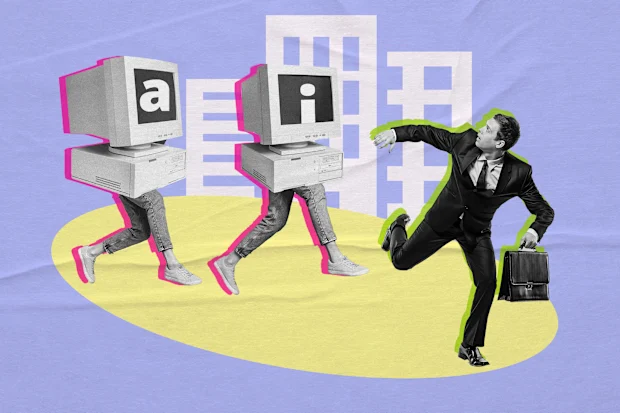

Let’s stop pretending this is a future problem.
AI isn’t knocking on the door anymore. It walked in, sat down at your desk, and started answering emails. And honestly? It’s faster than you.
That’s not a hot take. That’s Tuesday in 2026.
The Quiet Replacement
Here’s what nobody talks about at company meetings. Businesses aren’t firing people and replacing them with robots. That would be dramatic and obvious. What they’re doing is quieter. They’re just not hiring the next person.
Someone leaves. The team absorbs the work. An AI tool fills the gap. The position disappears from the careers page. No announcement, no headlines, no protest. Just one less salary on the books.
Marketing teams are using AI to write first drafts, generate campaign ideas, and produce visuals that used to take a designer two days. Customer support runs on chatbots that handle 80% of tickets without a human ever seeing them. Legal departments use AI to review contracts in minutes instead of hours.
And the people still employed? They’re using AI too — because if they don’t, someone who does will replace them.
Who’s Actually at Risk
Not everyone is equally exposed. If your job involves repeating patterns — writing templates, sorting data, answering predictable questions, producing routine content — you’re in the blast zone.
Here’s the uncomfortable truth: it’s not just factory workers and drivers anymore. The new wave is hitting white-collar professionals. Copywriters, junior analysts, entry-level designers, paralegals, customer service reps, bookkeepers. Jobs that require skill but follow patterns.
The people who are safest? The ones doing work that’s hard to template. Strategy, relationships, creative problem-solving, physical presence, emotional intelligence. The stuff that doesn’t fit in a prompt box.
The Numbers Don’t Lie
Companies using AI tools are reporting 30-40% productivity gains in content production. Some coding teams claim they ship features twice as fast with AI assistants. Customer support departments are running with half the staff they had two years ago.
These aren’t Silicon Valley experiments. This is happening at mid-size companies, agencies, e-commerce brands, and startups everywhere. The tools are cheap, they’re good enough, and they’re getting better every month.
“But AI Makes Mistakes”
Yes, it does. And that’s the argument everyone clings to. “AI hallucinates. It gets things wrong. It can’t replace human judgment.”
True. For now.
But here’s the thing: humans make mistakes too. Humans also call in sick, ask for raises, need management, take lunch breaks, and quit after two years. AI does none of those things. From a spreadsheet perspective, “occasionally wrong but always available” is winning against “usually right but expensive and unpredictable.”
Is that fair? No. Is that what’s happening? Absolutely.
So What Do You Actually Do
Panicking doesn’t help. Neither does pretending it won’t affect you. Here’s what actually works:
Learn to use the tools. If AI is going to change your industry, be the person who knows how to use it, not the person it replaces. The best employees in 2026 aren’t competing with AI — they’re multiplying their output with it.
Move up the value chain. If your work can be described in a simple instruction, AI can probably do it. Focus on the parts of your job that require context, judgment, and relationships. That’s where humans still win.
Build skills that don’t template. Negotiation. Leadership. Creative direction. Client management. Sales. These are harder to automate than people think, and they’re becoming more valuable as the routine work disappears.
Stay flexible. The people who’ll struggle most are the ones who refuse to adapt. The job market is shifting fast. Being willing to learn new tools, change roles, or rethink your career path isn’t weakness — it’s survival.
The Real Conversation
The debate shouldn’t be “will AI take my job?” It already is, in some form, for a lot of people. The real question is: what are we going to do about it? Not just individually, but as a society.
Because right now, the productivity gains are going to companies, not workers. People are doing more with fewer colleagues and the same salary. That’s a problem that no AI tool is going to solve.
And that’s a conversation worth having out loud.
Got a take? Disagree? Think we’re being dramatic? Good. That’s the point. Come back tomorrow — we’ve got more to say.